
RAID server crash at a business
“Our RAID server unexpectedly crashed at our business, putting critical data at risk.”
Recovered over the weekend, with all the vital information back.
Business server recovery
When a file server, database host or VMware datastore goes down, what you do in the first hour matters. Power it down, don’t rebuild, and call our 24/7 emergency line at (410) 937-7332.
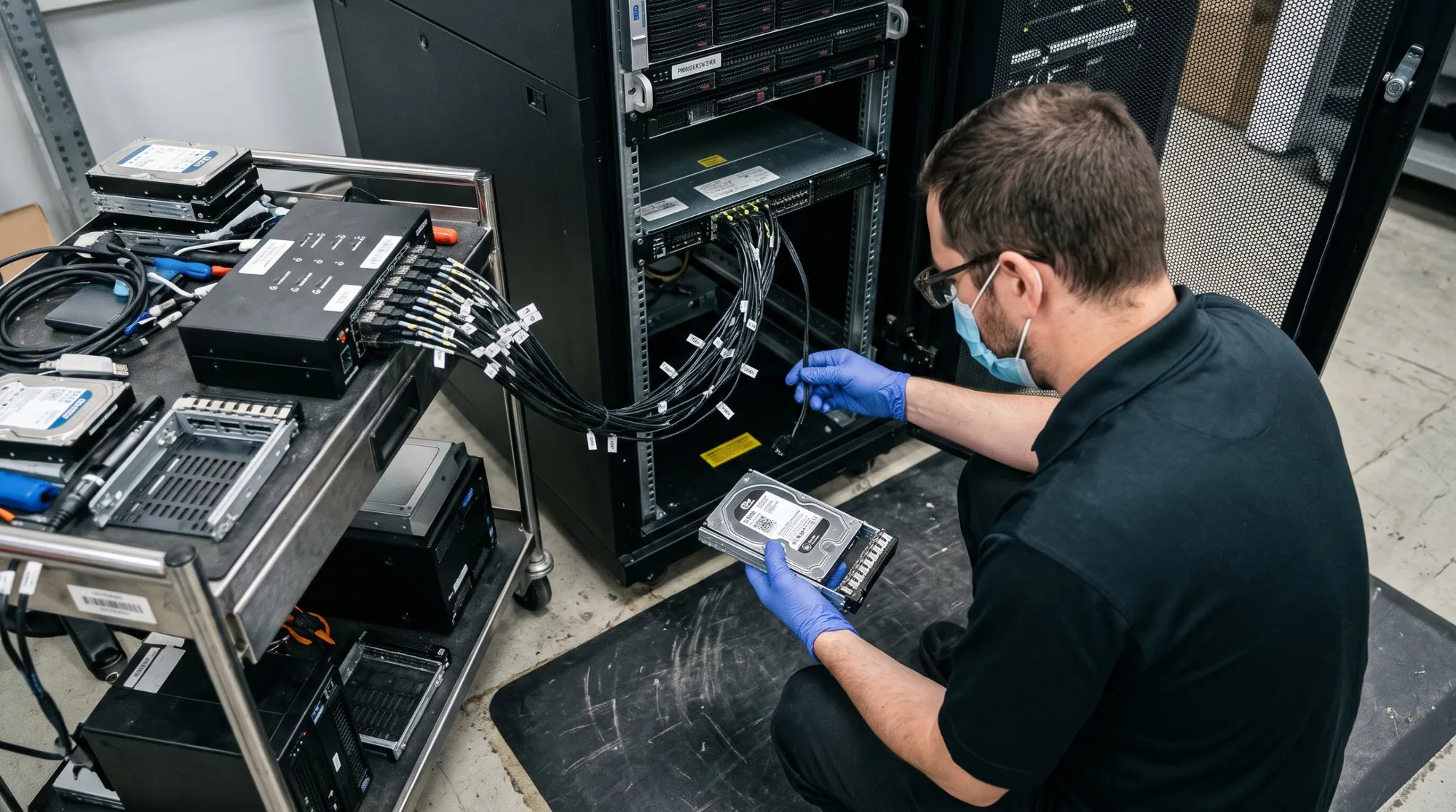
This page covers server data recovery for organizations whose work stops when one box stops. Usually that is a rack or tower server with a RAID card, running Windows Server, Linux, or a hypervisor with several virtual machines on top. Sometimes it is an older machine nobody has touched in years until it fails.
You don’t need a large IT department to use us. Business data recovery starts with a phone call from whoever is on hand, an office manager or an outside IT contractor. We have done this work since 1991, and the lab is ISO 9001 certified.
RAID controller failure. The card dies, loses its configuration, or marks healthy disks as foreign after a firmware update or power event. The data is usually still on the members. The risk is someone importing, initializing or rebuilding the set to get it back online. Dell PERC, HP Smart Array, LSI/Broadcom and Adaptec cards store their metadata differently, but the first step is the same: clone every member, then map stripe size, disk order and parity position from the clones. Guessing the layout on live disks adds writes.
VMDK and VHDX corruption. A VMware datastore or Hyper-V volume goes missing, or a single virtual machine won’t boot. Snapshot chains break, thin disks run out of space, or a LUN disappears after a failover. We assemble the array from clones first, then check the virtual disks, then the filesystems inside them. A volume that mounts but is missing its VMs is not a finished job.
Filesystem damage. ReFS, NTFS, ext4 and XFS volumes can fail after a crash, a bad shutdown or a repair attempt. Running a repair tool on the original disks writes to them. We work on images instead, and verify the filesystem on the assembled image rather than by booting the original controller. Linux software RAID and Windows Storage Spaces get the same treatment.
Ransomware. We don’t decrypt ransomware and we won’t promise that anyone can. What we can do is examine the disks for data the attack did not reach, such as older or unencrypted copies. Results depend on how far the encryption got and how long the system kept running. Disconnect the server from the network, but don’t wipe or reinstall it.
What to do and not do in the first hour:
On-site diagnostics are available. Call us for details or to arrange a visit.
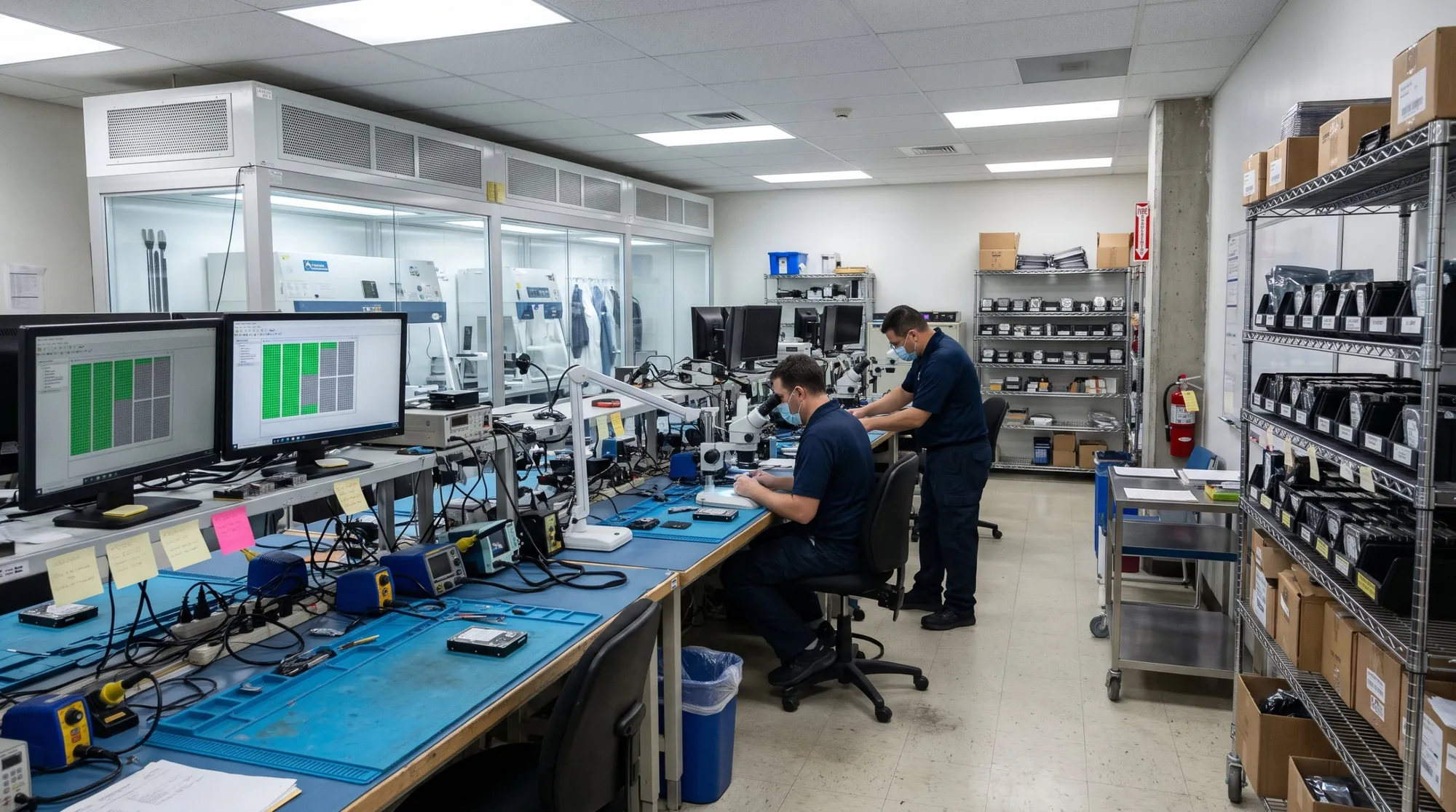
Recovery itself is done in our Columbia, MD lab.
Servers hold payroll, patient records, client files and contracts. We treat them that way. Medical and legal clients, and anyone else who needs it, can request a written chain-of-custody record when the disks come in.
A down server is a business outage. Call the 24/7 emergency line at (410) 937-7332 and tell us the RAID level if you know it, how many disks, which bays failed, whether a rebuild started, and whether the server held virtual machines. Form enquiries get a reply within one business day.
Bring the disks to our Columbia lab at 10015 Old Columbia Rd, Suite B 215, Columbia, MD 21046, weekdays 8:30 a.m. to 5:00 p.m. You can also ship the disks to us free both ways. Pickup is available too; call or use the form for details.
Once all disks arrive, RAID and physical jobs usually take 3–7 days. The evaluation is free. You get a fixed quote before any paid work, and if we can’t recover the data you need, you don’t pay the recovery fee. Over 15,000 cases recovered, with a 95% success rate.
“Our RAID server unexpectedly crashed at our business, putting critical data at risk.”
Recovered over the weekend, with all the vital information back.
Their business hard drive went down in the 2023 Western Digital hack and the business was at a standstill.
“We were back up and running in 24 hours.”
Example scenario based on the kinds of failures we see. Not an individual client result.
Both drives in one mirrored pair of a RAID 10 array fail, one quietly days before the other. Forcing a drive back online in the RAID controller BIOS corrupts the VMware datastore, and the virtual machines disappear.
How we handle it: We connect every SAS drive to write-blocked equipment and image the failing drive in several targeted passes. Then we rebuild the RAID 10 mirrors virtually, repair the VMFS datastore, and extract the virtual machine (.VMDK) files, including SQL databases, for verification.
Lesson: Forcing an offline drive back online through the controller can overwrite good data with stale data. Image first.
Often, yes. We clone the disks, rebuild the RAID in software, then recover the VMFS datastore or Hyper-V volume and check each VMDK or VHDX. Don’t install a hypervisor on the broken disks to test them.
Power the server down, label the disks by bay, and don’t import or initialize them on a replacement controller. Send us every member disk, including the ones marked failed.
Yes, written chain-of-custody is available on request. Recovered files are returned on new media, and we don’t keep copies longer than needed to confirm delivery.
On-site diagnostics are available. Call us for details or to arrange a visit. The recovery itself is done in our Columbia, MD lab.
RAID and physical jobs usually take 3–7 days after all disks arrive. For an urgent outage, call our 24/7 emergency line at (410) 937-7332 rather than using the form.
All recovery work happens at our Columbia, MD lab (walk-in Mon–Fri, 8:30 a.m.–5:00 p.m.). Our Tysons, VA office sees clients by appointment. Ship your drive to us free both ways. Pickup is also available, call for details. 24/7 emergency line: (410) 937-7332.
Related: RAID recovery · Virtual machine recovery · NAS recovery · What affects the cost
Tell us what failed. We reply within one business day, and you get a fixed quote before any paid work. No data, no charge.